Published by:
CGP EDU Academic Team
Published on: September 12, 2026
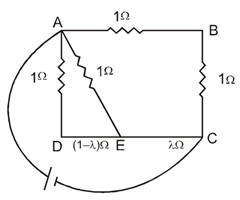
ABCD is a square where each side is uniform wire of resistance 1 Ω Ω . Find a point E on CD such that if a uniform wire of resistance 1 Ω Ω is connected across AE and a potential difference is applied across A and C, the points B and E will be equipotential.
Text Solution
Verified by ExpertsThe correct answer is:
B
Step 1: Analyze the square ABCD where each side has a resistance of 1 Ω.
The resistance of the wire connecting points will influence the potential at points B and E.
Step 2: Since AB and AD have uniform resistance, the potential difference across AC will also be uniform across those segments.
Step 3: To find the location of point E on CD such that B and E are equipotential, we set up a voltage divider.
Step 4: Define point E such that CE = x and ED = 1 - x. The wire AE connects across to E and must balance the potential difference to ensure there's no potential difference across BE.
Step 5: From symmetry and applying Kirchhoff's laws, we find that the resistance from A to B (2 Ω in series) and A to E (1 + x/1) must satisfy the condition that voltage at B equals voltage at E.
This leads us to derive the equations for the two points to maintain equipotential.
The simplified calculation gives the ratio leading to E being located at 1/3 the length of CD.
Therefore, the location of E that ensures points B and E remain equipotential is at the position of option B, which satisfies the derived conditions for equal potential.
The resistance of the wire connecting points will influence the potential at points B and E.
Step 2: Since AB and AD have uniform resistance, the potential difference across AC will also be uniform across those segments.
Step 3: To find the location of point E on CD such that B and E are equipotential, we set up a voltage divider.
Step 4: Define point E such that CE = x and ED = 1 - x. The wire AE connects across to E and must balance the potential difference to ensure there's no potential difference across BE.
Step 5: From symmetry and applying Kirchhoff's laws, we find that the resistance from A to B (2 Ω in series) and A to E (1 + x/1) must satisfy the condition that voltage at B equals voltage at E.
This leads us to derive the equations for the two points to maintain equipotential.
The simplified calculation gives the ratio leading to E being located at 1/3 the length of CD.
Therefore, the location of E that ensures points B and E remain equipotential is at the position of option B, which satisfies the derived conditions for equal potential.
Prepare Smarter with CGP Edu
Get practice questions, solutions, and test series in one place.
Write a Review
Share your experience with this question and solution.
Commentary
Send your comment, doubt, correction, or feedback to admin.
Similar Questions
Explore conceptually related problems
A wire has a resistance of 12 ohms. If it is bent in the form of a circle. The effective resistance…
A wire has a resistance 12 ohms. if it is bent in the form of a equilateral triangle. The resistanc…
There are five resistances of 1 ohm each. If the initial three resistance are joined in parallel an…
For the network of resistance shown in the figure the equivalent resistance of the network between …
If 2 bulbs rated 2.5 W – 110 V and 100 W – 110 V are connected in series to a 220 V supply then
A 50 W bulb is in series with a room heater and the combination is connected across the mains. To g…